Flat Roofing & Flat Roof Repairs in Blanchardstown
Is the flat roof over your extension or garage leaking, or are you planning a new covering? Emerald Isle Roofers Dublin is based in Blanchardstown and carries out flat-roof repairs, replacement and new installations in the area. We assess the roof before recommending the scope; a leak alone does not mean the whole covering needs replacing.
Tell us where the property is, which roof section is affected and where water appears indoors. You do not need to know the material name before enquiring. The covering, supporting deck, drainage and connections to the building all influence which repair or replacement is suitable.
Materials and work covered
Our flat-roof work covers torch-on felt and reinforced bitumen systems, EPDM rubber, GRP fibreglass, PVC and FPO/TPO single-ply membranes, and liquid-applied systems. These are different covering families, not interchangeable patching materials. Repair products and methods need to be compatible with the existing roof.
The agreed work can include joints, laps, edges, upstands, rooflights, flashing and outlets, alongside damaged roof boards or insulation where required. For a new installation, the covering needs to work with the roof design, support and drainage. For an existing roof, the condition of those components helps determine what can be retained.
Leaks over extensions and garages
A damp mark beneath an extension or garage roof may not sit below the entry point. Water can travel along the deck or another part of the roof before appearing indoors. The assessment therefore considers the covering and nearby details rather than placing a patch directly above the stain without checking its cause.
Joints and laps connect parts of the covering; upstands are the raised details where it meets a wall or other feature. Rooflight kerbs, edges, flashing and outlets can each provide a water-entry route if their detail fails. Tell us whether the symptom follows particular weather, occurs near an adjoining wall or has returned after previous repairs.
For investigation of an uncertain source, see our roof leak diagnosis and repair service.
How the flat-roof covering affects the repair
Torch-on felt uses reinforced bitumen layers, with laps and details that need to form a compatible weatherproof covering. Splits or failed details may sometimes be repaired locally if the surrounding material remains suitable. The use of heat requires professional controls; this is not work for a homeowner to attempt.
EPDM is a rubber membrane whose joints, trims and penetrations require suitable components and preparation. GRP is glass-reinforced plastic, commonly called fibreglass, with a cured covering and formed details. Movement, cracks or an unsuitable substrate can change the repair needed; putting a generic coating over the visible fault is not a diagnosis.
PVC and FPO/TPO are different single-ply membrane families. Existing sheet type, seams and adjoining components matter when selecting a compatible repair. Liquid-applied systems cure to form a continuous covering, but suitability depends on the substrate, preparation and specified system. Their ability to follow a roof's shape does not mean they can be applied over any damaged or wet roof.
For signs that warrant professional assessment, read signs a flat roof needs repair.
Roof boards, insulation and outlets
The deck is the supporting surface beneath the covering. Deteriorated boards can prevent a sound repair even where the visible membrane damage looks small. Where replacement is needed, suitable plywood or OSB and the supporting arrangement should be selected for the assessed roof; not every board product is appropriate merely because it fits the space.
Insulation and vapour-control layers are considered as part of the roof build-up where relevant. A leak does not automatically mean all insulation needs replacing, but wet or unsuitable concealed layers can affect the proposed work. The quotation should distinguish known replacement or upgrade work from areas whose condition needs further inspection.
An outlet is where rainwater leaves the roof. Standing water can involve the falls, a restriction or the outlet detail, not just the surface covering. The assessment should consider how water reaches and leaves that point so that a new covering is not presented as a solution to an unresolved drainage problem.
For help distinguishing interior moisture patterns, read roof condensation or a leak.
Repair or replacement?
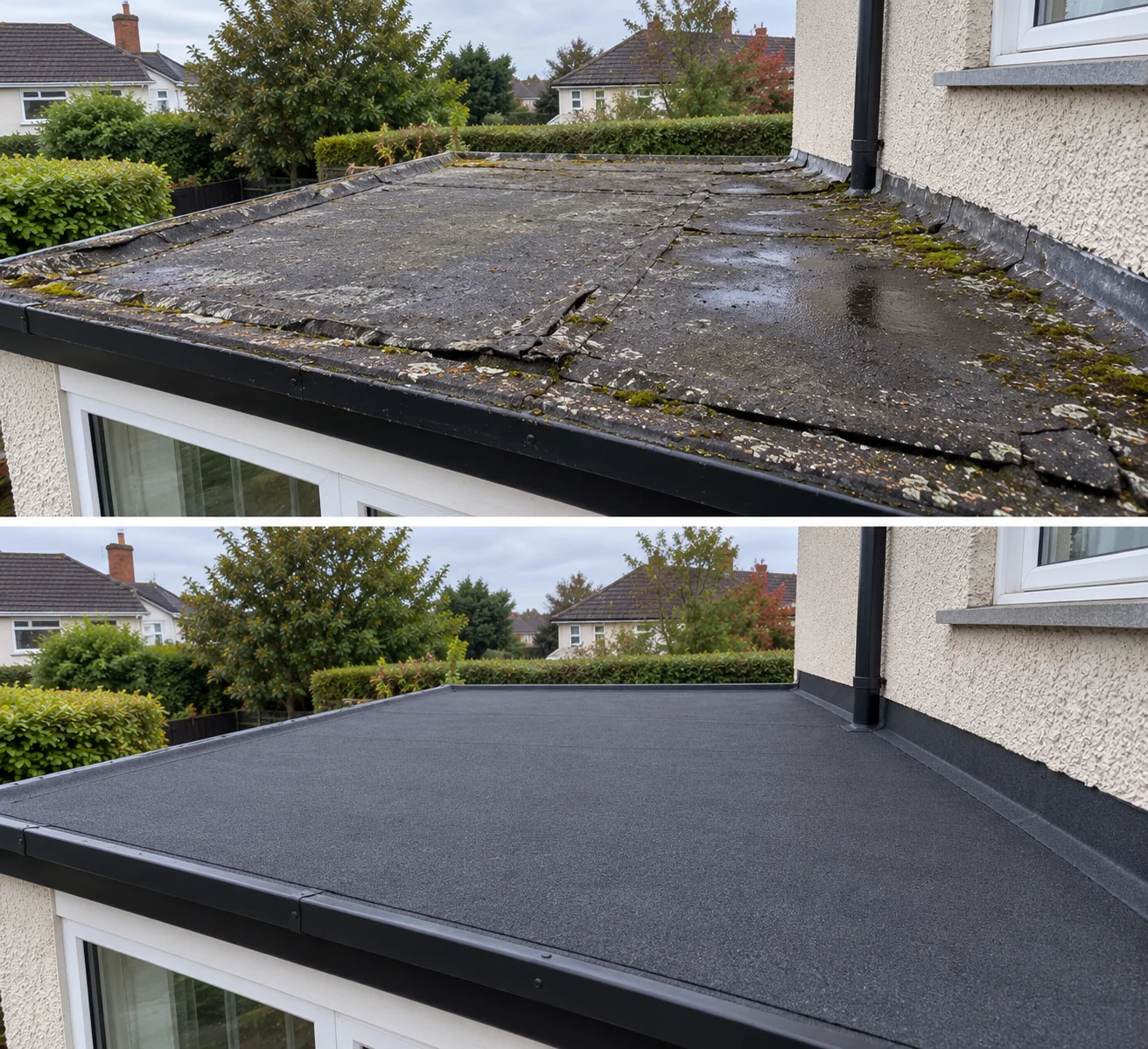
A contained repair can be appropriate where the fault is identified and a compatible repair can join reliably to sound surrounding material. This may involve a damaged section, seam or detail rather than renewing the entire roof. The condition beyond the visible fault matters because a patch cannot compensate for widespread failure beneath or around it.
Replacement may need consideration where deterioration is extensive, several details keep failing or the deck needs substantial work. The recommendation should explain the evidence and the roof sections involved, not rely on age alone. Where both approaches are reasonable, ask for their different scopes, retained components and limitations to be made clear.
Quotation, materials and access
The written scope should identify the roof area, proposed covering or repair materials, affected edges and junctions, and any outlet, deck or insulation work included. It should distinguish repair from replacement and explain where the new work meets retained roof sections or the adjoining building.
Access above an extension, safe material handling and protection of the space below need discussion before work is agreed. If opening the roof reveals additional damaged boards or other concealed issues, the findings and proposed changes should be explained and authorised. Do not assume that all concealed work is included or that extra work can proceed without agreement.
Nearby Dublin 15 coverage
Our Blanchardstown base also serves nearby Clonsilla, Ongar, Mulhuddart and Huntstown. Include your locality and say whether the roof covers a garage, extension or another part of the property. Mention rooflights, adjoining walls and access constraints if you can describe them safely from ground level.
Do not climb onto a flat roof to check for pooling, test the boards or identify the membrane. Flat roofs can conceal weak areas, and the edge may be unprotected. Photographs taken safely from the ground and a description of when water appears are enough to start an enquiry.
For ongoing care and inspection guidance, read flat-roof maintenance for Irish homes.
Frequently asked questions
Do I need to know which covering is on my flat roof?
No. Tell us which roof area is affected and what you have noticed. Previous invoices or specifications can help if available, but do not climb up or disturb the covering to identify it. Its type and condition can be assessed before suitable materials are proposed.
Can you repair the flat roof on an extension or garage?
Yes. The existing roof needs assessment to establish whether a compatible local repair is practical. A faulty edge, joint or outlet may need a contained repair, while widespread deterioration or deck damage can change the scope. A leak over either type of building does not automatically require a full replacement.
Can a liquid coating fix any leaking flat roof?
No. A liquid-applied system needs a suitable substrate, preparation and compatible specification. It cannot be assumed to solve wet insulation, damaged boards, movement or an unresolved drainage detail. The cause and roof condition should be established before a coating or any other repair is recommended.
Can damaged roof boards or insulation be included?
Yes, where they are needed and agreed. The quotation should identify known deck and insulation work separately from the covering. If concealed damage is found later, the additional scope needs explanation and approval rather than being treated as an automatic part of the original repair.
Does a leak mean all the insulation must be replaced?
Not necessarily. The extent of moisture, the roof build-up and the condition of affected materials need assessment. Sound components should not be condemned from an interior stain alone, but wet or unsuitable layers should not be hidden beneath a new covering without addressing the problem.
Can repair and replacement be compared in the quotation?
Where both are suitable options, their scope and limitations can be explained. Ask which roof sections and details each option addresses, what remains in place and whether deck, insulation or drainage work is included. The comparison should be based on the assessed roof, not a promise that one material is best for every property.
For the wider Dublin service, see our flat roofing page.
For other work at the same property, see roofing services in Blanchardstown.
Request a Roofing Quote for Flat Roof Repairs in Blanchardstown
Send Emerald Isle Roofers Dublin your details and a short description of the work required.
Emergency roofing: 083 158 8431